Showing posts with label Mick Mars. Show all posts

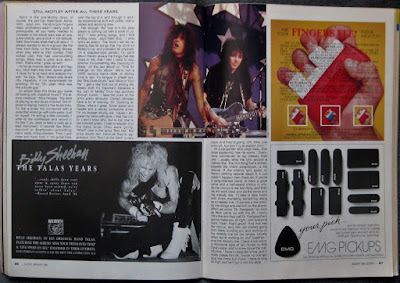
Nikki Sixx and Mick Mars in Guitar Magazine, January 1990


"The bass player claims he's really just a songwriter. The guitarist can only solo on one chord. Both say they ought to practice more often, but then admit too much practice could lead the band to ruination. They wouldn't be motley anymore. But, wait a minute: the guitarist spends his off hours composing classical themes for cello and violin. The bass player is about to release a book of poetry. What is going on here?" 

John Stix's Guitar Magazine interview with Nikki and Mick is one of the most detailed accounts from the 1980s of the Motley string men as working, creative musicians. Both frankly admit their limitations while showing a deep awareness of their talents and how they approached their roles in one of the world's then biggest Rock bands.  


Mick speaks of creating out-of-character Rock instrumental music with a combination of his Blues Rock sensibilities and Classical music touches. He also talks in depth about key and position preference and reveals he is not overly comfortable in E or A which is surprising as they are often the most native, popular keys and positions for Blues Rock players.


Nikki discusses a book of poetry and lyrics he was planning on publishing but never saw the light of day. The book was to be a mix of Motley lyrics with as many new songs and poems and was later titled "An Education In Rebellion."  
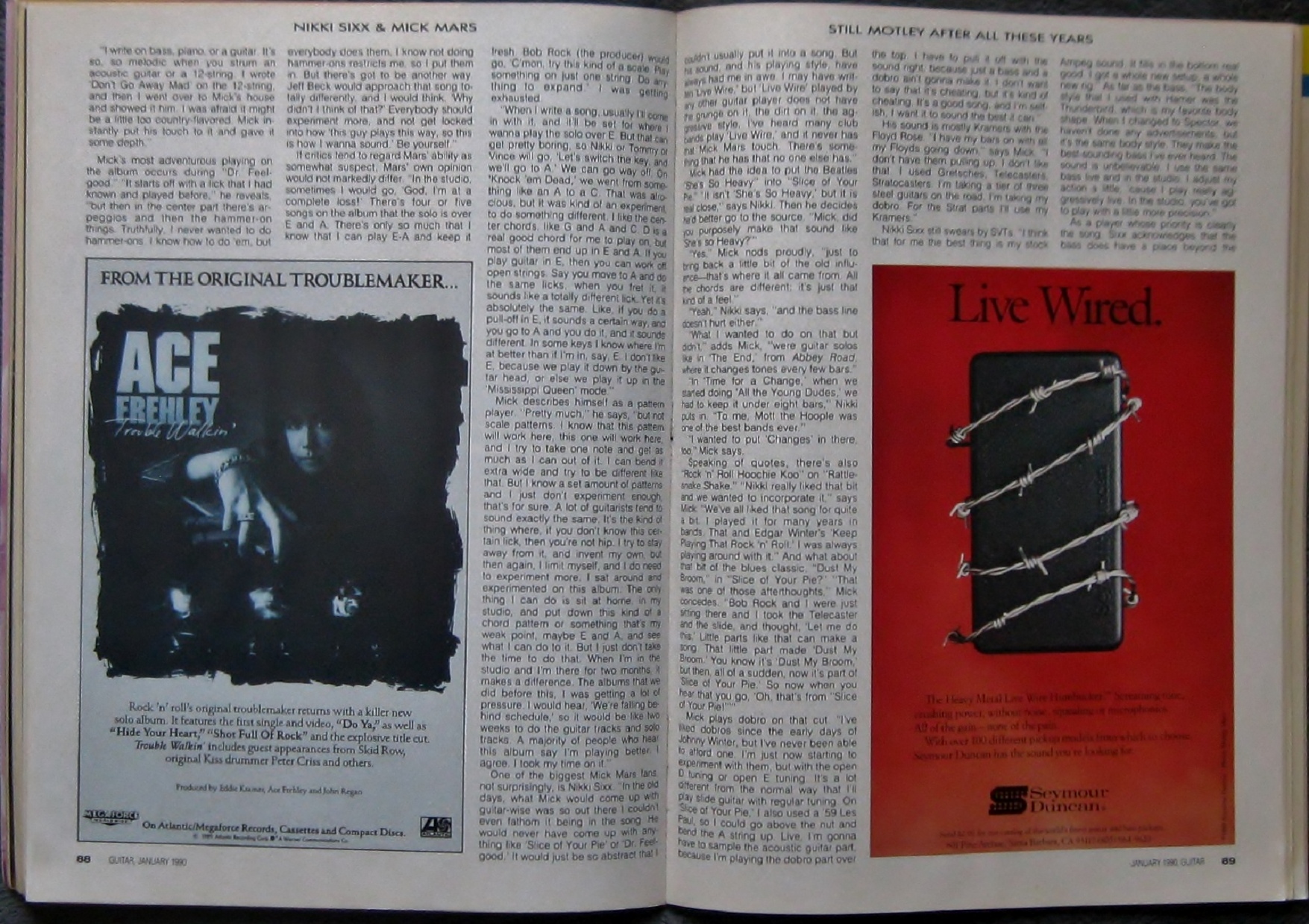

Among the more fascinating details in this interview is Nikki's walk-through of Motley's songwriting process. From writing on acoustic guitars to Mick's electric guitar additions to having Vince mumble melody ideas, Nikki lays out the process which yielded such classics as "Don't Go Away Mad" and "Dr. Feelgood". This is the type of information that was not often asked of or offered from the Crue and it is a welcomed change.


Mick says he will soon be working on a solo record . . . which, in 2020, is still unreleased but has been teased and may be released in the next few years. He ends the interview by admitting that though perhaps more accomplished players may criticize his technique, they know his sound which is original and recognizable. Amen, Mr. Mars.

Guitar Magazine offered guitar and bass transcriptions for "Dr. Feelgood" and the back cover of the edition has a Kramer Guitars ad that features Nikki and Mick among Rock cohorts who had taken part in the Moscow Music Peace Festival months prior in August, 1989, around when this interview would have taken place. 

Motley Drawings, Part II: Not-So-Good Kid Art


In my first post sharing my childhood Motley Crue art from school friends there were some really cool images. In today's post? Not so much. Some friends were better artists than others. Some of these were drawn by really young kids and look like it but I was always happy to receive some Crue art from a friend. Enjoy these pieces from the 1980s to the early 1990s.


February, 1992 - The End of Motley Crue PART I


To get a sense of where Motley were at this time, let's go back just a few months to October, 1991 in Canada where Mick and Nikki were doing a publicity junket for the new Crue retrospective Decade Of Decadence. I recorded a bunch of stuff from their day at Much Music and Musique Plus (Canadian English and French video music channels in the 1980s-1990s). The video below has Nikki talking about the future sounds of Motley. What folks don't always remember is that Motley were about to enter a slightly more progressive, heavy and experimental phase of music with or without Vince. Even before Dr. Feelgood came out in late 1989, Nikki was talking about experimenting with the Motley sound. They flirted with Rap music on a few demos that never passed the demo stage. The albums Motley Crue (1994, without Vince) and Generation Swine (1997, with Vince) show us, in compromised settings, what some of the new Motley music sounded like just before Vince quit/was fired from the band. The keyboard, experimental music Nikki, Mick and Tommy were writing that Vince didn't like became the foundation of the sound fans would hear on  Motley Crue with John Corabi on vocals. Motley started jamming with John only a week after Vince was fired.


The following two interviews with Nikki and Vince for Hit Parader Magazine have the soon-to-be-parted band mates talking about the bond between the members and how it was never going to end . . . almost like they're over-compensating for conflicted feelings. 


I heard the news at school the day it was announced. A kid came up to me in the hallway and laughed, 'Hey man, Vince got kicked out of Motley!' I remember walking home and tuning into Much Music waiting to hear the confirmation ... and it came. February 14th the band issued a press release about the parting. Here's footage of the Vince MTV interview mentioned in the Metal Edge notice, above. We're going back to the week of February the 18th in our Crue history books. 


Lonn M. Friend is the talking head in this second video. He was the editor of Rip Magazine and it sounds like he was talking to Nikki and is sharing some of what was said about the parting. MTV talked to Vince on the phone in the ensuing days and a camera crue [cough -ed.] caught up with him in Long Beach on April 12th where he was racing (and crashed twice).


Nikki, Mick and Tommy held a band meeting on February 11th and voted Vince out. The Crue told the world about it that Friday, on Valentines Day, and then remained quiet while Vince did a huge publicity response, appearing and being reported on a wide variety of television entertainment shows. We'll share more TV clips of Vinnie trying to process the firing and more magazine articles from the vaults.

Mick Mars Part 4: Popular Unpopular, 1991

This is a great interview with Mick conducted by RIP Magazine's Editor-In-Chief, Lonn M. Friend in August 1991 when the Motley's were in England for the Monsters of Rock Festival.


Mick is a funny guy & displays a lot of the special charm he has through some (rare) interviews back in the day. He's also, clearly, a misanthrope & displays a general dislike for the human race! He's especially honest here with longtime friend, Friend, & talks about his co-members with a welcomed candor. He talks shop & tells us how some of his most classic riffs were written ('Girls, Girls, Girls': drunk as shit), details on how he & the Crue sobered up, his working relationship with then-wife & Nasty Habit, Emi Canyn & the future of Motley.

Motley Who?

 
So exactly WHO are Motley Crue? In 2015 they are bona fide Rock Legends with an impressive staying power and biz savvy. They are also an example of the tired nostalgia culture that has been a leading force in the music industry since the 1990s (& before). The band has never again achieved the artistic success that reached its peak in the early 1990s with 'Primal Scream' & the 1994 John Corabi album, nor did it ever duplicate the sheer power & honesty of their first two records. 

 
Motley have had several lives. Even within the first decade there are so many details; tragedies and songs about them, changes in appearance & style of music. A LOT happened from 1981-1991 in Crue land. Then there's the short-lived Corabi period. After that the middling years: Motley, completely irrelevant artistically, releasing clumsy new music & keeping their heads down, doing their work while the world moved on. 


The reason they are here today, to my mind, is because of the success of the 2001 Neil Strauss-penned bio, 'The Dirt'. It hit at just the right time, finding an audience rabid for 1980s raunch & hedonism sprinkled with enough pathos to turn the head of a Greek dramatist [cough, we'll work on that one later! .ed]. Known to us old-school Crueheads since the mid '80s, Motley's story is one of epic proportions that may or may not contain moments of exaggeration & hyperbole. Nonetheless, the book proved that, alongside a songbook that has aged better than many of their contemporaries', the Motley myth was more rich, more honest & more compelling than your average Classic Rock band.


 Although the music they made after 1994 is not essential listening it can sometimes be interesting & entertaining. Had the Brunette Three (Mick, Nik & Tom) picked a more 1990s-sounding singer to replace Vince (John Corabi was a Steven Tyler-styled vocalist) OR called the Corabi band anything other than Motley Crue I think we could have had a second band that would have continued until now, even alongside the Motley machine. I for one am a fan of the Motley Crue album from 1994 but I do think a slightly different handling of that whole situation (like not firing Vince at all but taking a break & doing a record with a different singer) could have made a much richer Motley legacy. Alas, it wasn't to be.

Classic Rock Magazine Polls #3: 1989-1990


Motley's two & a half year hiatus from releasing new music meant that a whole lotta upstarts jumped into the limelight. By 1989, bands like Warrant & Skid Row & Poison came to define what has become popularly known as 'Hair Metal'. Motley were always a Glam band in the mold of 1970s pioneers like Alice Cooper, New York Dolls & Kiss, but with the emergence of 1980s Hard Rock, Glam got a new look and a new cast of characters. In those two & a half years, a highly successful breed of bands would emerge & threaten to topple the Crue from atop the Hard Rock heap.


 In 1989 Hard Rock was still big business & Motley released Dr. Feelgood unto a world which had already heard Guns N' Roses, Cinderella, Poison, Skid Row, Warrant &, in a different vein, Metallica (as can be seen by their placing in many of the poll categories). And although songs like 'Dr. Feelgood' & 'Kickstart My Heart' are powerful examples of 1980s Hard Rock at its finest, the Crue were not offering anything overly revolutionary or new. In a way, it was the first time in their career they could be said to have been overt followers of trends in Hard Rock. 


Despite this tough competition, Motley fares out well in this Circus Magazine poll for the year 1989 (published in the February 1990 edition), winning the coveted top spots: 'Band Of The Year' & 'Album Of The Year' for Dr. Feelgood. Vince hadn't won the 'Lead Vocalist Of The Year' for two polls running but was happy to comment on Motley's other wins in the article above. He talks about the band's success despite not much radio or video play & remarks how the band's audience has expanded to include younger & more general Rock fans (a trend that two years later would make Metallica the world's biggest Rock band). Vince congratulates Skid Row on their success & once again remarks on the different nature of Motley & Bon Jovi.


Sharon Liveten catches up with Nikki while the Crue are rollin' on the Feelgood tour in 1989-90. The Sixxster is in high spirits & discusses the bass guitar (he won 'Best Bassist') & laughs that the band also won 'Comeback Of The Year', insisting the Crue were assured of their success with Dr. Feelgood all along. Tommy also won 'Best Drummer' (again) but we do not get a feature on the Motley basher.


Circus printed a chart of all the Reader's Poll winners from 1984 to 1989 & Motley's dominance & popularity in those years is surprising. They certainly were not as successful or as popular as bands like Bon Jovi, Def Leppard or AC/DC, so why were they the darlings of so many of these teeny-bopper Metal & Hard Rock magazines? Was there something more personal & intense about the Motleys?


Tommy & Nikki sound politely impressed when Metal Edge Magazine Editor Gerri Miller presents them with plaques for their wins in the 1990 Reader's Choice Awards. The duo often won in their respective categories, a testament to their talent (Tommy) & their popularity. MORE Magazine Poll Awards to come at the Sleaze Patrol Files!!